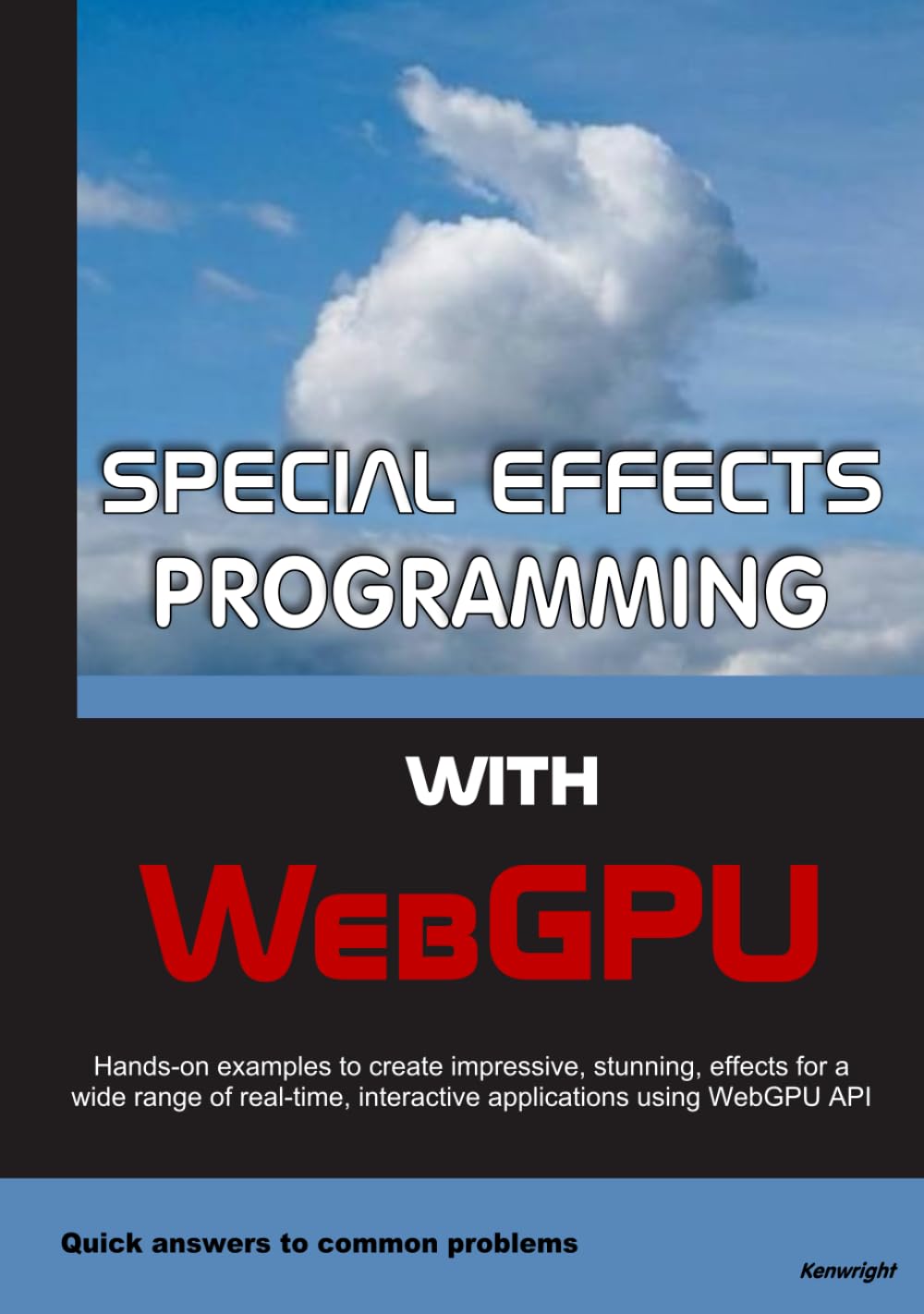
"Special Effects Programming with WebGPU (Hardback)" offers a cutting-edge perspective on webgpu, as it demystifies the challenges and opportunities within the data-driven world.
By combining visionary ideas with grounded examples, "Special Effects Programming with WebGPU (Hardback)" empowers readers to engage deeply with the future of wgsl. Each chapter builds momentum, weaving together case studies, frameworks, and forward-thinking analysis that elevate the discourse. The book’s tone is both authoritative and accessible, making it a standout resource in the realm of webgpu.
This book doesn’t just inform—it challenges assumptions and introduces a bold, refreshing framework for thinking differently.
The diagrams and visuals were top-notch—clear, purposeful, and genuinely helpful in understanding the concepts.
July 12, 2026
If you're serious about mastering graphics, this book is essential. It’s both a guide and an inspiration.
I found myself nodding along constantly—so many moments of 'aha!' throughout the book.
July 12, 2026I was impressed by how seamlessly the book connected theory with practice. It felt like a roadmap I didn’t know I needed.
July 9, 2026
The author's tone is confident yet welcoming, making even the most technical concepts feel approachable and empowering.
Yes! I found the visual summaries at the end of each chapter incredibly helpful for reviewing and retaining key ideas.
July 10, 2026The diagrams and visuals were top-notch—clear, purposeful, and genuinely helpful in understanding the concepts.
July 13, 2026Stay updated with the latest in tech literature
This first appeared in Lit Hub’s Literary History newsletter—sign up here. Famously, O. Henry (the pen name of William Sydney Porter), author of...
Read MoreThese snakes can go for months without eating, grow and shrink the size of their hearts and jump start their metabolism on a dime....
Read MoreMatthew Medney, author of Existence Equation, recommends three of the most thought-provoking science fiction novels ever written....
Read MoreEnhance your reading and learning experience
Choose a quiet, well-lit space free from distractions to optimize focus.
Create a dedicated reading space with good lighting and minimal distractions.
Space out your reviews over days or weeks to reinforce long-term retention.
Scan headings, summaries, and key terms before deep reading to build context.
Rubber Duck Debugging: explain your code line by line to an inanimate object.
Follow the 20-20-20 rule: every 20 minutes, look at something 20 feet away for 20 seconds.
Sarah Johnson
Professional ReviewerThe diagrams and visuals were top-notch—clear, purposeful, and genuinely helpful in understanding the concepts.
July 19, 2026